
How AgX Uses Iterative Prototyping to Accelerate Formulation Success
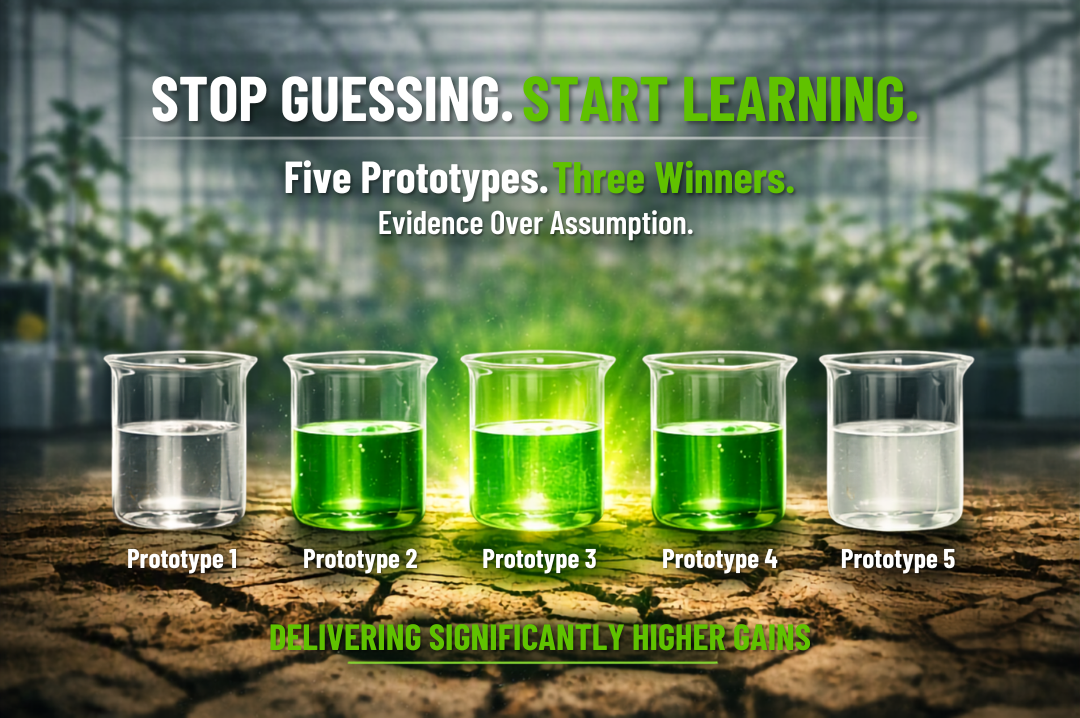
When AgX set out to help a crop protection company defend a market-leading fungicide from generic competition, the answer wasn’t a single reformulation. It was five targeted prototypes, tested side by side in the greenhouse. How many hit the mark? We’ll get there in Case Study 1.
Around the same time, another client needed an insecticide that could hold up in scorching, arid growing conditions, on a timeline with no room for guesswork. AgX built four prototypes to find out which formulation could take the heat. Only one made the cut. More on that in Case Study 2.
Part 1 of this series established why iterative prototyping matters. Part 2 gets into the how: the methods, tools, and decision-making frameworks AgX uses to help innovators reach field-ready formulations with greater speed, clarity, and scientific confidence.
Starting With the Right Boundaries: Product Design Analysis
Every AgX project starts with a Product Design Analysis (PDA), a structured evaluation that defines the viable formulation space across chemistry, regulatory, environmental, and commercial dimensions. (See Market Driven Formulation Design for more on AgX’s Product Design Analysis.)
This upfront clarity means every prototype that follows is purposeful, not exploratory. We don’t start experimenting until we know exactly what problem we’re solving.
Prototype Development: Hypothesis-Driven Formulation Work
Once the formulation space is defined, AgX moves into controlled, hypothesis-driven prototype development. These aren’t early drafts of a final product, they’re purpose-built experiments designed to answer specific questions about stability, compatibility, delivery, and performance.
AgX’s approach emphasizes:
- Systematic exploration of formulation types — a structured approach that quickly eliminates formulation types that don’t fit the target use pattern, application method, or biological requirements.
- Ingredient ratio optimization — proprietary, small-scale methodologies that speed up the iterations needed to understand ingredient interactions and functional contributions.
- Co-formulant screening — drawing on AgX’s internal knowledge base to identify emulsifiers, dispersants, stabilizers, adjuvants, and carriers that meet compatibility, environmental, and regulatory requirements.
- Processing parameter refinement — assessing robustness, scalability, and batch-to-batch consistency under realistic manufacturing conditions.
Each prototype is built around a clear hypothesis. Each iteration isolates a single variable to quantify its impact, creating a disciplined structure that drives rapid learning, early elimination of weak options, and advancement of only the formulations that strike the right balance of stability, efficacy, compatibility, safety, and scalability.
Case Study 1
Five Prototypes, Three Winners: How Iteration Protected a Flagship Product
Challenge: A crop protection company needed to defend a market-leading fungicide ahead of patent expiry and anticipated generic competition. The goal was clear: achieve more than 10% improvement in efficacy against key diseases compared to the existing standard.
Approach: AgX developed five distinct prototypes, each designed to optimize delivery, uptake, and performance through variations in adjuvant systems and formulation chemistry, then evaluated them side by side in greenhouse trials.
| 5 prototypes tested side by side
3 exceeded the >10% efficacy target 2 delivered significantly higher gains |
Result: The client advanced its top candidates earlier, reduced field trial uncertainty, and strengthened its competitive position ahead of generic entry.
Case Study 2
Finding the One: Iteration in Extreme Environmental Conditions
Challenge: A client developing a new insecticide for hot, dry environments on leafy vegetables needed to identify a viable formulation fast, within a tight development timeline.
Approach: AgX built four distinct prototypes across different formulation types and put them through iterative greenhouse testing designed to reveal performance differences under stress conditions.
| 4 formulation types tested under stress conditions
1 standout candidate identified and advanced to field trials |
Result: The client narrowed to its most promising candidate within the project’s tight timeline. That formulation is now progressing toward commercialization — proof that early-stage iteration accelerates development while reducing downstream risk.
Rapid Testing: Physical and Biological Evaluation Working Together
AgX uses quantitative scoring systems to evaluate prototypes consistently across projects, showing not just whether they pass or fail but why and by how much. Physical property testing (thermal, humidity, and storage stability; dilution behavior and tank-mix compatibility; viscosity, pH, and particle size; emulsion quality) runs in parallel with controlled biological studies (early efficacy signals, phytotoxicity screening, dose-response trends, performance under stress), feeding transparent, comparable data into every decision point. This is the engine behind both projects above: every prototype cycle, in both the fungicide and insecticide work, was scored this way before the next decision was made.
Iteration: Turning Data Into Direction
Behind both projects is the same disciplined decision-making process. After every cycle, AgX walks clients through four questions:
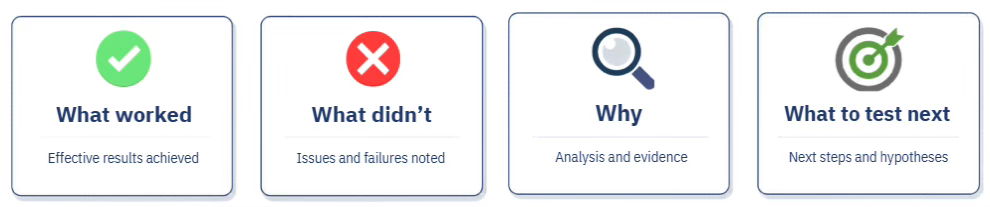
That feedback loop, grounded in evidence rather than assumption, is what let the fungicide team advance three strong candidates instead of gambling on one, and what allowed the insecticide team find its one standout formulation before the clock ran out.
Conclusion
The results from both cases tell the same story: structured, hypothesis-driven iteration, anchored to commercial and regulatory realities from the start, delivers faster timelines, lower development costs, reduced field trial risk, and stronger scientific confidence before scale-up.
AgX’s value isn’t only in building formulations. It’s in building the right formulations, aligned to the intended market, use pattern, and regulatory environment, and with the evidence to prove it.